The Agent Store Is Coming. Here’s What That Means.

We’re entering a new frontier — the Agent Store, akin to App Store but filled with autonomous AI assistants. Think of jotting down “travel agent,” “CFO assistant,” or even “model gimp,” and voilà — you browse, install, and transact (or should we say “hire”). No prompts needed, no integration headaches.

Why is it happening?

  • Developer monetization must evolve. Just as apps needed a marketplace, our GPT + tool ecosystem demands distribution, review, billing, recursion.
  • User demand for turnkey agents. Most users don’t want to build prompts (and they are actually not that good at it!) — they want to install “deal‑sourcing agent” or “legal memo writer” and then go back to the water cooler conversation.
  • Infrastructure is ready. With persistent memory, API access, LLMs with tool use, and billing frameworks already live, the missing piece has been distribution. And Microsoft already released an embryonic version in April 2025. Expect many more soon.

What will it look and feel like?

  • A curated storefront: categories, ratings, developer info, pricing tiers (free, freemium, subscription).
  • Seamless install: tap, authenticate once, agent begins working across apps.
  • The emergence of voice: Two way conversations will very likely start taking significant market share from our thumbs as an input/output device, especially on mobile devices.
  • UX expectations & POAs: sandboxed permissions, digital Powers of Attorney, clarity of capabilities, ease of uninstall — just like mobile apps, but intelligent.
  • Evolution of autonomy: Simple Powers of Attorney will be replaced with ever increasing autonomy over time.
  • Transparent billing: platform revenue share, PCI‑compliant subscriptions, reviews and updates managed like iOS/Android.
  • New managerial skills needed: MBAs will now need to get good at managing teams of non-human agents.

What should existing startups and companies do now?

  1. Build agent‑native not just APIs. Start by layering memory, autonomy, tool orchestration.
  2. Prepare UX and billing flows – be store-ready early. Think onboarding, onboarding-to‑subscription, audits, support.
  3. Differentiate with data: proprietary customer data = AI moat — especially in verticals like fintech, legal, compliance.
  4. Start building distribution partnerships. If OpenAI, Anthropic, or Gemini open a GPT store, early agents gain discoverability.

What should new founders do?

  • Pick niche, move fast. Build domain‑specific agents where vertical knowledge matters — e.g., K‑1 tax prep, credit underwriting, ESG reporting.
  • Validate fast with no-code stores like Custom GPTs. Gather feedback and iterate.
  • Plan revenue share: think subscription tiers, usage fees, white‑label models. Monetization is table‑stakes.
  • Engage the community. Launch a waiting list, host previews, build a reputation. Early agents likely get featured.

Is it a land‑grab?

Absolutely. The first wave of agent stores will be winner-takes-most. Expect:

  • Featured position bias: curated picks dominate downloads.
  • Network effects: as more users flock to certain agents, integration partners follow.
  • Platform lock‑in: store policies, bundling restrictions, revenue shares define who wins.

Winners will be those that arrive early, deeply verticalize, price smartly, and evolve with platform policy — not just code against GPT-4.

At QED were here helping fintech manage the transition to mobile as companies like Nubank and Braintree spearheaded that evolution. We are very excited to help the next generation of fintech founders think through this exciting platform shift. We are only a call away!

AI and Privacy: It’s Good to be King

In a world where AI may be coming for our jobs, we all need to find our edge – that one thing we do better than anyone else, AI or human. We had explored this topic in our last blog, where we had likened today’s AIs to B+ professors on any given topic, and had concluded that to stay relevant we need to perform at A+ levels in our specific fields.

Today, let’s look at another, but related topic. Do these “B+ professors” keep a copy of the homework we give them? In other words, are these non-human super intelligences keeping our personal data? And if so, is that a good thing or a bad thing?

The facts pertaining to this question are hard to know for two reasons. AI makers tend to dodge transparency, and the policies they do have tend to shift fast.

But to the best of our knowledge today, it seems that Grok stores the least amount of personal data (any personal data supposedly gets erased when a session is ended), and it appears Google’s Gemini stores the most, with 22 out of 35 possible data types, including precise location, browsing history, contacts, chat logs, and much more.

The precise nature of, and the legality around the personal data that is stored is a topic that will surely feed legions of lawyers and their offspring for generations. But for the purposes of today, let’s take a step back first. Is it actually desirable  for this data to be harvested, stored, and then used?

To take Grok as an example, it says it does not store the data, but in my own personal experience I find that I want it to have access to this data! In fact, I would happily share all my personal data with Grok – from biometric readings, to all browsing history (well, let’s make that almost all browsing history).

The thesis here being that Grok can give me even more amazing answers if it only knew me better. I could get better feedback, better recommendations, and perhaps it can even pre-emptively advise me on my health and spot any issues before it is too late.

And more importantly, having Grok know me better, would immeasurably improve the tone of our conversation. Like some sort of Victorian era butler that knows all my whims and wonkiness, it could make me feel like a master of my world. As Tom Petty sang, “It’s good to be king, if just for a while.”

But none of this comes for free. In the context of AI, unregulated access to personal data is such a powerful thing to give, and we are so close to granting AI this very access, it is probably worth pausing to think of the consequences.  Such an AI would know us better than we know ourselves, and therefore it would be better at predicting our individual and collective actions then any human ever was historically. From changes to relationships to the outcomes of elections, it would start to seem to us the AI would be able to know the future.

And as Thales demonstrated to us more than three millennia ago, with his famously profitable bet on olive oil presses after predicting a bumper harvest in the spring, knowledge can easily be converted to both power and money. The only thing that has changed is that what is being harvested is not olives, but personal data on a vast scale. The geolocation, biometrics, and secret wishes of billions is about to fuel the emergence of an oracle the ancient Greeks could only have dreamed about.

This is a near perfect illustration of something we see in fintech all the time. Innovation depends on expanding the boundaries of technology as well as the rules and regulations that govern the use of said technology. And not surprisingly, in virtually all cases, the technology tends to be way ahead of human regulations. What we also see is that the best fintech founders know how to push those boundaries forward in a balanced way.

The fact that regulations are struggling to keep up with technology does not mean that we don’t need rules and constraints, a topic we will explore in more depth in our next blog. In the meantime, let’s enjoy that feeling of power that comes from having computers serve us.


It’s good to get high and never come down
It’s good to be king of your own little town

Tom Petty, “It’s Good to be King” Wildflowers, 1994

AI and the Workplace: Will Grok Eat My Lunch

In our last blog, we looked at the philosophical implications of AI, and concluded that if an All Knowing Intelligence (“AKI”) emerges, it may be able to predict the future with great accuracy, or at least much better accuracy than we humans can. And we played around with the slightly trippy idea that for such an entity both the past and the future may become equally deterministic, so it would likely have a very different concept of time compared to us mere humans.

I admit, that was quite abstract, so today, let’s think about something a bit more practical, and close to home. Will an AI take my job?

Given that this is a big and complicated question, let’s start with picking the low hanging fruit in terms of answers.

One, AI will definitely change your job, and as anybody reading this knows, it has already.

It is then tempting to jump to the seemingly related and very well trodden truism that AI will not take your job, but somebody using AI better than you will. While this sounds funny and catchy, I sadly have some bad news – AI may in fact take your job. Querying answers to your bosses questions in ChatGPT is not keeping you safe. Sorry to be the bearer or bad news there.

Then again, the idea that there was somebody out there using AI better than us already was very likely scary to begin with, so perhaps this added revelation hurts a bit less.

But what is one to do? How do we keep our jobs and livelihoods safe?

Well, here is one thought. As a good friend of mine used to say, “be so good they cannot ignore you”.

A mental model that I have of the best AI in the market currently, is that it is like having access to a B+ level professor in any given subject.

You want to understand behavioural finance and the works of Thaler, Kahneman and Tversky? Ask Grok or Gemini and they will give you answers in any format you like. You are interested in mid 13th century mystic philosophy in Asia Minor? Or how the Roman Empire went from being a republic to a dictatorship? Or theoretical physics and quantum theory? That B+ level professor is there for you, around the clock, anytime you wish.

And mind you, the B+ categorization doesn’t refer to the quality of the answers per se. It means that the answer you are getting are of the quality you would get from a person that studied this subject, wrote a Ph.D. thesis on it, and went on to become an expert in that very subject, no matter which subject your question was about.

Which begs the question, what does it not get you? Why not A+ level answers? When does AI’s limits show up?

Well, if you are an expert in your field, and you are facing very specific and cutting edge questions, AI may not be able to give you the full answer. At least not yet. For the most difficult and cutting edge questions (as well as new discoveries) around theoretical physics, someone like a David Deutsch will still not be easy to replace with an AI. And think about the best fintechs out there – AI helps, but founders drive it.

So, what’s the conclusion here? Whatever you do, try to be the very best at what you do. As the Marvel character Wolverine famously said, “I am the best there is at what I do, but what I do isn’t very nice”.

Perhaps the corollary in this case is to be the best there is at what you do, but what you do may have to be razor sharp.

Oh, and if you just blindly copy and paste comments from ChatGPT into your work e-mails and memos, AI will eventually take your job. Find your edge over AI – you know you have it in you!

Determinism, Free Will, and AI

First, a bit of a warning. This blog is less about fintech and investing, and more about philosophy. And it gets a bit trippy towards the end. So, if that’s not your thing feel free to wait for the next instalment which is likely to be about reassuringly familiar topics around tech, money and AI.

In the meantime, speaking of AI, let’s look at it for a moment in the context of determinism vs. free will.

For those not familiar with this philosophical paradox, I usually frame it as follows: If an all knowing being existed, given its all-encompassing knowledge of the universe, it would be able to run the tape forward one click and predict the future with ease.

We can think of this entity as God, or All Knowing Intelligence “AKI”, or the Conscious Universe, but in either case, given its vast intelligence and knowledge, the future would be knowable for It.

This being would know the state of every electron and synapse in our primate brains, and predicting what we were about to do next (write a blog perhaps?) would be trivial.

The paradox then states, if each of our actions are thus pre-ordained to this AKI, can we as humans really be thought of as having a free will? Or are we simply slaves to the interaction between the universe as it is today and the current configuration of the synapses in our brain, acting out our lives in banal predictivity?

But here’s where AI shakes it up.

The way I had approached this question for the vast majority of my adult life was that it was a trick question. From the perspective of the AKI, yes, all is knowable, but from our limited human perspective it is not. So as far as we humans are concerned, we need to act as if free will exists and get on with our lives. And whether an AKI or God exists takes us from the realm of philosophy, into theology.

Well, now that we have ever faster and more powerful computers ingesting seemingly unlimited data, rapidly connecting to those data sets, and with LLMs actually speaking to us like our next-door neighbour, it may be worth visiting the question of an AKI once again.

Given the power, the connectivity and access to near all-encompassing data, this AKI would be able to see and understand things beyond human capabilities yet explain that to us in our everyday language. And while perhaps not yet fully deterministic, it would certainly be able to predict things better than humans can.  This almost takes us out of philosophy and into the present day. Think of AI already predicting your next Spotify song – it’s not God, but it’s close.   

But let’s jump back into philosophy for a second and assume that the AKI is as the name implies, truly All Knowing. What does that mean for the age old questions?

For an AKI, the future is knowable. Similarly, the past, which has already transpired, is also knowable, and is merely a matter of good record keeping.

Given that both the future and the past are equally knowable from the perspective of this AKI, the distinction between past and future, at least the way we humans think about it, would start to collapse.

What we think of as past and future would be different states of matter and energy interactions in the universe. In simpler words, all that would remain would be an ever lasting yet ever changing present.

From this perspective, the concept of time itself starts to collapse, and reveals itself as an illusion that is amplified by our limited human minds that can remember the past but cannot predict the future. In fact, our human attempts at measuring time is really just an incomplete proxy for measuring change. Einstein’s discovery that time itself is relative can be thought of as a step towards saying time as we know it does not exist.

Only matter, energy, and everlasting forces of change do.

2025 Fintech VC Predictions

In the spirit of the new year, here are some predictions of what will happen in fintech land in 2025:

A virtuous loop between more M&A and IPOs
More M&A was a prediction from last year that certainly has materialized, in the QED portfolio as well as elsewhere. We expect that momentum to continue in 2025 and it will be further bolstered by another emerging (and very welcome!) trend of more fintech IPOs. Just as QED European alumni Klarna recently announced their IPO, we expect more public offerings to be revealed in the coming year, creating a virtuous loop for even more M&A as companies use acquisitions as a tool to accelerate scale either in preparation of or as a consequence of their IPOs.

The visible hand of the government vs. the Invisible hand of the market
More regulation is another 2024 prediction that certainly came to pass, both in Europe and the USA, but we expect this to acquire a new flavor in 2025. Specifically, while there will be a lot of regulatory action in places like the EU, the US looks poised to move to domestic de-regulation (lower taxes, more lenient enforcement, etc.) while moving to more regulation (primarily tariffs) in an international context. The net result of these non-market interventions is that market players will increasingly look to (and try to lobby!) governments to act in their favor. So, expect more lobbying and more reading of the political tea leaves in tech circles!

Crypto spring
Looking at the trajectory of Bitcoin over the last month, this perhaps seems like an obvious prediction, but it is important to note that it will continue to be driven by several secular factors including: i.) more friendly U.S. regulation, ii.) more sanctions and other types of disruptions to international trade and iii.) recent price increases will once again attract masses of retail investors.

Climate tech
This is a secular macro trend that will not abate anytime soon, and especially in Europe, where the EU sees itself as a global regulatory trendsetter, there will continue to be regulatory as well as consumer-driven tailwinds. Add to this the ever-decreasing costs of producing alternative energy, and the table seems set. The one countertrend here would be more tariffs on Chinese-made solar panels slowing down the pace of cost decreases.

European & UK wake-up calls on listings
The IPOs of Klarna, and very likely in the not-too-distant future Revolut, may well take place in the U.S. when they happen. This will surely serve as a ‘bucket of cold water’ for the policymakers in the UK who wish to revive the fortunes of the London Stock Exchange, and London as a listing venue in the face of headwinds that have included decreasing liquidity, more onerous governance, Brexit noise, and sanctions impacting areas such as mining where the London market had a historical niche. Expect some soul-searching, public debates, and hopefully some tangible changes as a result.

What’s Afoot in Wealthtech, and Can Robots Make Me Rich?

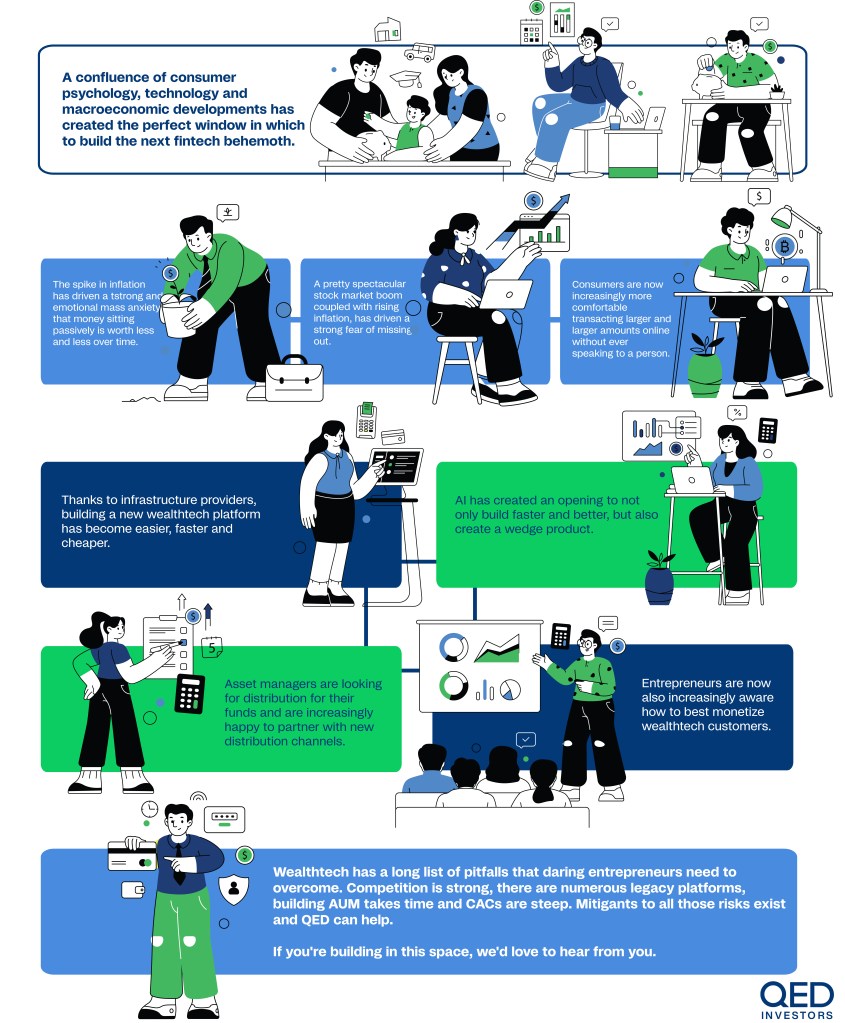
There is a lot happening in the world of wealthtech, and for good reason. A confluence of consumer psychology, technology, and macroeconomic developments has created the perfect window in which to build the next fintech behemoth.

The first set of changes, while in many cases macro driven, are best understood through the lens of the consumer where three salient trends stand out.

One, the spike in inflation over the last couple of years has driven a strong and emotional mass anxiety that money sitting passively in a bank account is worth less and less over time.

Two, in case nobody noticed, we are in the midst of a pretty spectacular stock market boom despite all the negative political headlines. This, along with rising inflation, has driven a strong fear of missing out and has pushed many people to look for ways to join the party. So while inflation caused fear, the rising stock market has triggered that other driving force in finance, greed. 

Three, consumers are now increasingly comfortable transacting larger and larger amounts online without ever speaking to a person. Whereas the idea of handling transactions in the hundreds of thousands if not millions of dollars without speaking to somebody would have caused trepidation in the majority of people a decade ago, that is no longer the case. In fact it is fair to say that the opposite is true now, where having to speak to somebody is usually a sign in people’s minds that something has gone wrong!

The second set of changes are technology and industry driven, and are best understood through the eyes of the entrepreneurs who are looking for the next exciting company to build.

One, the world of fintech has now evolved such that thanks to infrastructure providers like QED investment Atomic, building a new wealthtech platform has become easier, faster, and cheaper.

Two, AI has created an opening to not only build faster and better, but also create a wedge product such as a trading coach that can help those looking to protect and build their wealth avoid common pitfalls and mistakes. These pitfalls are especially pronounced in the world of day traders where sadly many that are looking to build wealth end up depleting it.

Three, as the amount of offerings on both the public side (ever cheaper and more targeted ETFs for example) and private side (sought after private equity and venture capital funds) have proliferated, those asset managers are looking for distribution for their funds and are increasingly happy to partner with new distribution channels to consumers who are hungry for access. And given the more sophisticated APIs and fintech infrastructure, connecting to those funds is much easier.

Finally, entrepreneurs are now also increasingly aware how to best monetize wealthtech customers. Building AUMs is not cheap, and takes time and patience (as well as capital). However embedded fintech solutions in payments and FX, not to mention lending propositions such as Lombard loans (credit secured by a share portfolio) opens up the way for rapid and substantial monetization beyond the world of AUM driven commissions.

Of course, we live in the world of venture, and risk is an ever present part of all that we do. Wealthtech has a long list of pitfalls that daring entrepreneurs need to overcome. Competition is strong, there are numerous legacy platforms, building AUM takes time, CACs are steep, and on the more day-trading oriented platforms the consumer benefit is far from obvious.

The good news is that mitigants to all those risks exist, and we will look at those in our next blog. For now, if you are building in this space, let us know if QED can help. And as for robots making us rich, that’s already happening, and if you are not benefitting from it you are probably falling behind!

10 Implications for Fintech of the SVB Collapse

The sudden collapse of SVB continues to send reverberations throughout not just the fintech ecosystem, but also the broader financial markets.

While in many ways it feels too early to look back on what happened, and events are unfolding live, we can nonetheless draw some conclusions about how the world has changed and how it will continue to change in the near future.

Here are ten implications of the new world we live in:

1. The ending of the forty year bull market in bonds will be a turbulent transition:

A lot has been written about the end of the forty year bull market in bonds that started in the early 1980s. A big driver behind this bull market was the macro economic impact of the demographic bubble represented by the baby boomers. Born right after the Second World War, this generation started entering their mid-thirties by the early 1980s, at which point they started accumulating capital at pace, which gradually but inevitably started putting downward pressure on real rates. Baby boomers are now entering their mid-seventies, and rather than accumulating capital, they are now decumulating it.

This was clearly not the only driver behind low rates – globalisation, technological improvements, and the emergence of developing countries all played major roles.

Whatever the causes, the bull market is now coming to an end, and as the SVB example painfully illustrated, the transition will be anything but smooth. They got caught on the wrong side of rate movements, and as confidence in their balance sheet collapsed, so did the bank, in a matter of hours.

Beyond SVB, considering debt to GDP ratios for sovereign countries also brings home the magnitude of the challenge that lies ahead. If a country has a debt to GDP ratio of 200%, a one percentage rise in interest rates, corresponds to 2% of GDP. As more income is diverted to debt service, budgets and consumption will shrink, with monumental consequences.

2. The perception of bonds will change:

As rates go up, bond prices decline. And the longer the duration of the bond, the more severe the reduction. We will now start to adjust to a world where bonds are not necessarily seen as safe havens, or more specifically, will only be seen as safe havens in cases where they can be held to maturity.

For example, a bond with a 1% coupon and thirty year maturity, has a duration of about 25, which means that if the rates rise by 1%, the price of the bond would go down by about 25%.

As rates rise, the reality of this simple math will reverberate through world of finance.

3. The narrative around how to allocate your pensions will change:

Over the last forty years, bonds yielded positive returns to holders as rates were going down. As this changes, bonds may very well return to more historical norms of close to zero real returns, or negative returns over short periods of time when rates increase rapidly.

This will have implications for how portfolios are constructed for the purposes of retirement and pensions.

Very likely, bonds will increasing be come to seen as a hedge against inflation, as opposed to a strategy for generating real returns. Inflation linked bonds that can lock in a real rate of return may also become more popular.

4. Banks will not be able to rely on income from bond portfolios the way they used to:

As the SVB example illustrates, bonds will likely have lower real returns, and hence become a less reliable tool for generating excess income, on bank balance sheets or elsewhere.

As a result, banks will likely start favouring lending where they can pass rate rises onto consumers, and make excess returns.

5. Lending platforms that can pass on cost of debt and manage risk effectively will become more valuable:

It follows from the above point that lending platforms that can generate low risk, high yield assets in a predictable and low yield fashion will become more valuable, and banks may in fact be willing to pay a premium to acquire such assets.

Clearly, in the very near term, there will be a lot of turbulence, and the natural tendency for banks will be to pull back and retrench. But as the dust settles, they will likely look to bolster their lending capabilities.

6. The Fed will have to make difficult trade-offs between inflation, financial stability, and unemployment and there may be no easy paths forward:

The Fed will have very difficult trade-offs to make in the coming months, and will very likely have to choose between reducing inflation or creating more market volatility. It is impossible to say which way they will act, but there will likely be a stark trade-off between reducing inflation vs. avoiding future events akin to the SVB failure.

Predictions are hard here, but one very possible outcome is that the Fed may end up raising its inflation target. This would have the added benefit (from the Fed’s perspective) of inflating away the debt burden.

7. Protectionism and the roll-back of globalisation may be a political response in many countries that ultimately has negative growth consequences:

Times of turmoil lead to simple narratives, and unfortunately, many of those simple narratives involve protectionism and anti-immigrant sentiments, just to name a few.

Ironically, globalisation, immigration, and trade are all forces that drive economic growth, and to the extent these are rolled back, growth will suffer further, potentially creating new challenges and reducing dynamism in the economy.

8. Bank consolidation will only gather pace:

Flight to quality in deposits will likely be a real thing, and this, along will all prior forces around economies of scale, will continue to drive bank consolidation.

9. Modern finance is faster:

The run on SVB happened at the speed Silicon Valley is used to, and it is fair to assume that this is the new gear modern finance will now operate at this moment henceforth.

Regulators will have to keep up with these challenges, and it is likely that the bank regulators globally will find ways to adapt, including the introduction of digital currencies.

10. Fintech is here to stay:

Finally, all this change means that the impetus for innovation in financial services will only increase.

To adapt to this new world, we will need visionary and skilled entrepreneurs along with expert venture capitalists willing to back them in order to help solve the new challenges presented by the brave new world of tomorrow.

SVB, the Power of Math, and World Pi Day

As the fintech and start-up community leaves a tumultuous weekend behind, we can now collectively take a deep breath and reflect on what transpired.

There will undoubtedly be a lot written about why SVB failed, what could have been done differently, and who should shoulder the blame.

The human psyche favours simple answers, and this tends to lead to a tendency where we want to find one primary cause for a big event. Reality, of course, is much more nuanced. When something big like a bank failure happens, there are a confluence of factors that come together, but our brains still crave that simple narrative.

If we look at SVB, the list of causes is long indeed: the fractional banking system has an inherent tendency towards bank runs, a very small percentage of the deposit base was protected by FDIC insurance which is designed to prevent such runs, the interest rate exposure on either side of the balance sheet was misaligned, they were very concentrated in one niche customer segment, the venture community can exhibit herd like behaviour, all moving at the speed of Twitter, they had a high Beta footloose deposit base, and so the list goes on.

But looking at that list there is one particular cause that is worth highlighting, especially in light of the fact that March 14th was World Pi Day (3.14), as this particular cause demonstrates the awesome power of simple math. That is the concept of bond duration, and what that did to their bond portfolio.

While there was a lot of publicity around the $1.8bn loss SVB realized when selling $21bn of bonds, there was another and bigger ticking time bomb on their balance sheet, which was the Held to Maturity (HTM) bond portfolio. As of September 2022, SVB had a bond portfolio in excess of $90bn, and the mark to market losses on that portfolio were a staggering $15.9bn, greater than their $11.5bn in tangible equity at that point in time, as was reported in their financial statements.

In other words, if SVB had been forced to sell its entire bond portfolio, the losses on that would have wiped out its entire equity book value plus some! But how is this possible – after all, bonds are supposed to be safe right? How can a bond portfolio crystalize such big losses?

It is very important to note here that there is nothing wrong with holding a bond portfolio to maturity, and in fact if one does so, there is no credit risk. And no loss would have crystalized. The bond does what it says on the label and you get the returns promised, it would just take many many years. The problem occurred because they had to sell today because of the run, and that laid bare the interest rate risk as explained below.

Let’s look at this interest rate risk, which brings us back to the power of math and the concept of bond duration which is fundamentally all about discounted cash flows and net present value. Here is a simple illustration.

If you buy a one-year maturity bond, with a 1% nominal coupon, when interest rates are also at 1%, that bond is worth par at your time of purchase. So you would pay $1,000, expect to get a $10 coupon plus the principal in one year’s time, discount that cash flow into the present with the 1% discount rate, and arrive at a $1,000 value. In other words, par.

Now, imagine that interest rates increase to 2% the instant you bought the above bond. Instead of discounting your expected $1,010 return on the bond by 1% to get $1,000, you would have to discount it by 2%, getting $990.19. Your bond is trading at a discount, and you just lost some money on your safe bond. Of course, if you hold your bond to maturity, you will still collect the $1,010 in one year’s time, but that money is only worth $990 today because we discount it at a higher rate. That is how bond math works.

But this was a one-year maturity bond, which incidentally has a duration of 1 (or close to it, depending on when the coupon gets paid) so the math was pretty simple.

If this had been a thirty-year maturity bond, we would first need to formulaically calculate the exact duration of the bond which is a measure how sensitive a bond’s price is to changes in interest rates. If we think of the cash flows flowing from the bond (the annual coupons and principal payment at the end) as bags of money positioned on a lever, the duration is the fulcrum point that balances this lever.

With a one-year bond that only pays one coupon at the end along with the principal, this fulcrum point is exactly 1. With a thirty-year bond that has a 1% coupon, it turns out that the fulcrum point is closer to 25 years.  

As a general rule, for every 1% increase or decrease in interest rates, a bond’s price will change approximately 1% in the opposite direction for every year of duration. So if we bought a thirty year bond, and rates went from 1% to 2% the day after we bought it, we would expect our bond to lose about 25% of its value, going from $1,000 to $750. So much for bonds being safe!

Now, clearly the folks that did this at SVB were aware of bond duration, and they had some sort of rate hedges and other instruments in place. However, the fact remains that they took on interest rate risk, and the duration math (as well as the rate environment) moved against them, and fast.

The fact that the Dodd-Frank rollback in the US (which happened in 2018) also reduced the buffer of shareholder funds needed to absorb such losses at banks did not help, and SVB was just under the $250bn threshold that would have come with more regulatory oversight and interest rate sensitivity stress testing.

While there are many learnings and insights from what happened, one is clearly to always work from first principles and be aware that the conventional wisdom around you may not necessarily be correct. As we just saw, bonds are safe only when held to maturity, and if you have to sell a long maturity bond early, math and markets can catch up with you.

When in doubt, always do the math. Much like Pi is a constant in math, make math a constant in your life.

A Guide to Local European Fintech Ecosystems: Top Five Impressions from Istanbul

As we continue to tour local European fintech ecosystems, we will share our top five impressions and highlights from each trip in order to give our followers a better sense of the rich and diverse fintech communities that are rapidly emerging across Europe.

The first in this “top five impressions” series will be Istanbul, which my partner at QED Investors Matt Burton and I visited in early January 2023.

Impression #1: While there is a lot of noise around inflation and politics, the Turkish economy remains very large and dynamic, albeit not without huge risks and imbalances.

The Turkish economy is currently getting most of its press in the Western media around the fact that inflation is running high at around 80% per annum. While this is true, and inflation has caused a lot of disruption for consumers and companies alike, a very striking fact upon visiting Turkey is how large and dynamic the economy is.

The population of 85 million in 2022 is now higher than any other country in Europe, and despite the inflation, the Istanbul stock market was up close to 100% in USD terms in 2022, with house prices having seen a similar rise with the influx of a lot of hot money from the region.

Having said that, the economy and the currency remain volatile, and Turkey is undoubtedly high on the macro risk index, especially if put into a European context.

Above: Trump Towers in Istanbul adds a certain color, diversity, and pizzazz to an already bustling business culture

Impression #2: There is a rapidly developing fintech ecosystem, with niche industries such as agricultural fintech developing rapidly.

Turkey has had its share of fintech exits (e.g. Naspers-owned PayU acquiring iyizico in 2019) and the current banking system is competitive, with high card as well as digital penetration putting Turkey on par with many Western economies. As an example, card penetration in 2019 was relatively high at 2.4 cards per capita according to a JPMorgan research report.

And while there is a lot of general fintech activity in Turkey, certain interesting sub-sectors such as agricultural fintech and logistics with an element of embedded fintech stand out the most. As an example, Tarfin, a fintech that has been operating in the market for close to five years, has pioneered innovative ways to fund farmers, both when they purchase seeds, fertilizers, and other factor inputs into agriculture.

Above: Turkey is a top three global producer in more than 20 fruit categories, and this richness can have big consumer benefits.

Impression #3: Istanbul’s historical role as a bridge between continents and cultures continues to be an asset.

Dating back to the East Roman Empire, which was later referred to as Byzantium and onwards to the Ottoman Empire, Istanbul has set at a crossroads of cultures and commerce. This is widely evident today in Istanbul, with a big influx of people from all surrounding regions be it Eastern Europe, Central Asia, Middle East, or Africa.

From a fintech perspective, this gives Turkey a very unique role to play especially in cross border trade, supply chain finance, and international remittance. As a result, there are many interesting fintech players emerging in these areas, such as Figo Para that is active in invoice discounting and supply chain finance.

Impression #4: Turkey is one of the top five crypto markets in the world.

Given the inflation and amount of cross border commerce, it is perhaps not surprising that Turkey is one of the largest crypto markets in the world in terms of user penetration. In fact, according to the website Analytics Insight, Turkey has the fourth largest crypto user penetration globally, at 18.6% (or around eight million users). Other countries with high user penetration include Argentina and Nigeria, which tend to be countries defined by frictions around dollar scarcity.

Above: This is not a food blog, but if we continue visiting Istanbul we may well turn it into one.

Impression #5: Elections are coming, and will be main story in the first half of the year.

Making political predictions in Turkey is not easy, and when asking locals to tell us what will happen in the upcoming elections, the divergence and implied uncertainty that is revealed by the answers is notable. What is clear is that these elections will clearly dominate headlines, while also adding an incremental amount of uncertainty into the existing mix.

No matter the outcome, we think that the fintech ecosystem in Turkey will continue to develop, with notable activity in payments, crypto, cross border commerce, and e-commerce enablement to name just a few.

In our next instalment in the local ecosystem top five series, we will turn slightly North West, and staying in the Balkans will look at the rapidly developing fintech ecosystem in Sofia, Bulgaria where QED led the Series A of Payhawk.

Five valuation formulas in finance that everybody needs to know

What are the five most important formulas in finance for company valuation? And how can you apply them to your everyday life, whether you are in the venture community or not?

1. The Time Value of Money:

Or, “a dollar today is worth more than a dollar tomorrow”.

The formula:

Present Value = Future Value / (1+r)^n, where “r” is your discount rate, and “n” is the number of periods.

Today’s inflation makes this clear:

Price of milk is increasing by 10% every year, so a gallon of milk that costs $1.00 today will cost $1.10 next year.

And $1.21 the following year. That $10 bill in your pocket buys you 10 gallons today, but only 8.2 gallons in two years!

The “r” in the formula is the discount rate at which we discount future profit.

$1 in the next period is only worth 1/(1+r) today.

And $1 in three periods is only worth 1/(1+r)^3. The further out the future cash flow, the exponentially smaller its value today.

It is also important to note that “r” takes not only inflation, but also risk into account. If your neighbor tells you they will give your $10 in two years, not only does that buy you less milk, but they may move house and never pay you.

Given the risk, you may want $5 today vs. $10 in two years!

So how can you apply time value of money to your life?

Be aware that with 10% inflation and 0% interest on your $9,000 savings account, you are $900 poorer at the end of the year. Congratulations, you just paid the inflation tax!!

Invest your money (wisely) and don’t let it melt away!

2. The value of a constant growth annuity:

Or, “even an infinite cash flow has finite value”.

The formula: Present Value = Perpetual Cash Payment / (r – g)

In this formula, “g” is the constant growth rate, and “r” the discount rate from Formula #1.

The simpler version of this formula is the No Growth Perpetuity – a cash flow forever that does not grow.

That formula is: Present Value = Perpetual Cash Payment / r

If “r” is 10% and you win the lottery to receive $1,000 every year that is worth $10,000 in today’s dollars.

You can apply this formula to value mature companies quickly:

If a company will only grow 5% over the foreseeable future, and is earning $10 million in after-tax profits, and your “r” is 15%;

The company is worth $100 million today.

$10mn / (15% – 5%) => 10mn / 0.10 => 100mn

There are many implications of this formula.

i.) companies & cash flows have finite value, driven by math

ii.) growth increases the value of future cash flows

iii.) risk & inflation decrease value

iv.) predictability decreases risk

You can see why “predictable growth” is something of a home run in valuation terms!

3. The Black-Scholes formula:

Or, “options have value”.

The Black-Scholes is a bit too complex mathematically to get into here.

But the implications of Black-Scholes are simple and valuable!

The implications:

i.) Options have value; never give one for free unless you are getting something in return

ii.) Value of options increase w/ volatility & duration

In risky times, (or if you are wise enough, before the risky times come knocking at your door), secure options.

Flexibility has value as it lets you pursue more options.

Value flexibility.

4. Enterprise Value vs. Equity Value

Or, “debt is never free”.

The formula:

Equity Value = Enterprise Value – Net Debt.

The best way to think of this is in terms of your house.

Your house may be worth $300,000. But you have a $250,000 mortgage – debt to the bank.

Your equity in your house is only $50,000.

The same concept applies to a company valuation. So in a situation where a company has taken on debt, we need to think of two concepts.

Enterprise Value: The analog to the value of the house from above.

Equity Value: The analog to “equity in your house”, or what is left when the debt is paid off.

If your valuation is based on net income, this is not an issue.

100% of net income is for equity holders, & is net of debt service.

But if your valuation is based on revenue or EBITDA you need to look at how much debt there is.

And subtract it from the Enterprise Value.

Implications:

i.) Debt gets paid of first. When enterprise value goes down, equity value gets wiped out first. Be aware.

ii.) Do not confuse enterprise cash flows (revenue, EBITDA), with equity holder cash flows (Net Income)

iii.) There are things that don’t look like debt, but are

iv.) When you are referring to a company’s value, especially in private markets, know if you are talking about enterprise value or equity value.

v.) Public markets do not have this confusion: All stocks are traded based on equity value.

vi.) Take on debt judiciously

5. The Capital Asset Pricing Model (CAPM)

Or, “return expectations are driven by inflation as well as a risk premium”

The formula:

Expected Return = Risk Free Rate + Risk Premium

The Risk Free Rate is measured by a safe asset such as a short dated U.S. T-bill.

This is what investors can earn without taking risk.

In the long run, this is very correlated with inflation.

In the short term there can be lots of deviations we need not get into here.

The Risk Premium is derived from:

– The overall risk appetite in markets (equity risk premium). This can go up and down based on the macro situation.

– The systemic risk of the security (also known as Beta, it is a measure of how much risk a security contributes to a portfolio).

Implications:

i.) Higher inflation => higher risk free rate, higher “r”

ii.) Macro uncertainty => higher equity risk premium, higher “r”

iii.) A risky venture => higher Beta, higher risk premium, higher “r”

More macro risk & more inflation, is not great for venture valuations!

In summary:

Pass on inflation into your net profits if you can. Predictability of growth will reduce your investors’ “r” &  increase valuation. Take on debt judiciously. We are in a new reality with valuations, get used to it, and accept it. Things will change, but only as the macro situation and the inflation outlook improves.