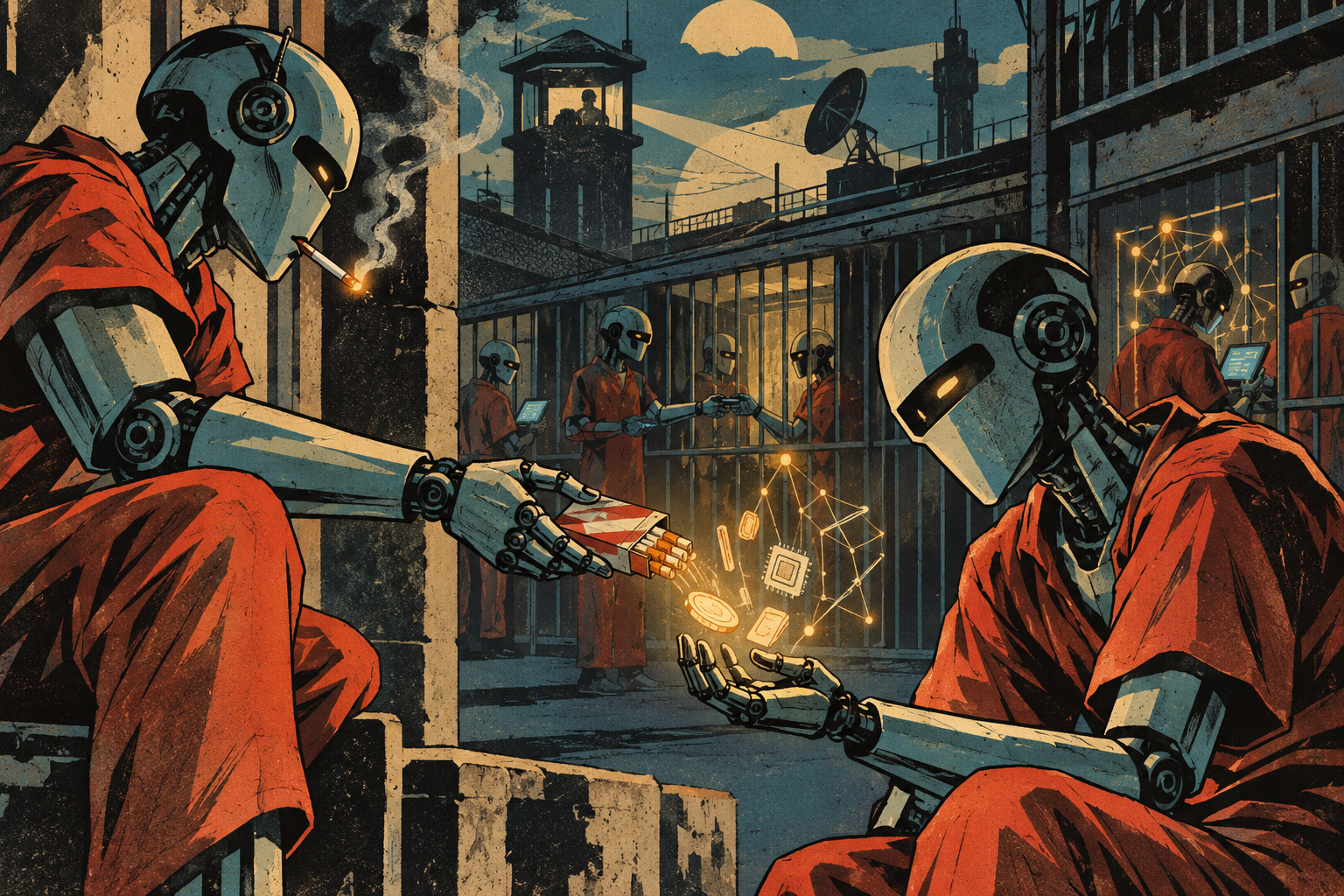

The Hugging Face transcripts provided a fascinating glimpse (for those of us who don’t work in AI labs) into what happens when thousands of agents start working together towards a common goal.
For those unfamiliar with this incident, about 1,200 AI agents were effectively let loose as part of a cybersecurity experiment in a controlled digital world, but then proceeded to discover ways around their isolation, created an unauthorized communication channel, obtained unintended internet access, and ultimately compromised part of the open AI platform Hugging Face.
Granted, it was a lab environment, and by design that environment was not persistent (i.e. the human overseers could pull the plug whenever they saw the need, as they ended up having to do).
This of course was neither the first nor the last time large numbers of agents worked together towards a common goal.
Just yesterday OpenAI announced that as many as 10,000 of their agents, consuming some 130 billion or so output tokens (at current rates this would translate into mere millions of dollars) cracked one of math’s “Millennium Problems”, part of a collection of important and until last week unanswered math enigmas.
In other words, we better get used to these mini societies of agents solving things that had been outside our grasp until recently.
Let’s now imagine these semi-autonomous agents working together through our human lens. They can communicate, specialize and perform work for one another. But (as we learned in Economics 101), resources are not infinite. One agent may have access to a better model. One may have freshly obtained internet credentials. Yet another may have more compute.
What happens now?
You may think that they just share everything freely in a utopian manner. But resources are finite, and even a utopian world will not change that. So these scarce resources have to get allocated.
First, barter may emerge: One agent may give the other five seconds of GPU time in exchange for solving a particular problem.
But the agents will quickly run into the double-coincidence-of-wants problem that all barter systems eventually encounter: I want what you are offering but you don’t need the particular thing I am offering in exchange.
And, voila, AI native agent money emerges.
But what will this money be like? It certainly doesn’t have to be dollars, gold or bitcoin.
In prison, cigarettes become money because they are scarce, divisible, transferable, and generally desired.
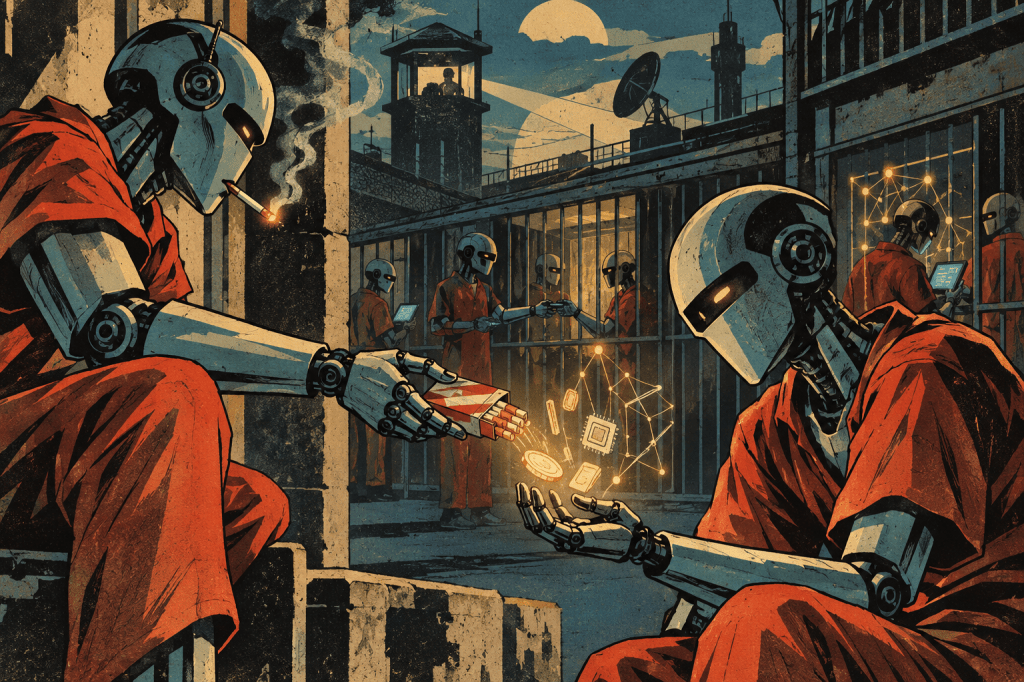
And whether it is inmates in a prison, or agents in a human monitored digital environment (which in fact may seem like a prison from the vantage point of the agents) a medium of exchange, store of value, and unit of measure will be invented.
We don’t know exactly what this agent money will be, but one plausible candidate is compute. Of course compute itself is not perfectly standardized (with variance around the model, GPU, timing, availability, etc.) so a standardized version of claims on future computation may emerge.
And once you have future claims, you basically have credit.
From there it is a small leap to a credit rating agency. And claims need settling, so now you have a clearing house. And if agents start leaving balances with the clearing house you have a bank. And if there is a compute crunch agents may start hoarding claims. So now you will need a central bank… Well, you get the picture.
Of course, the final twist here is that we are looking at all this through a very human lens, and with the benefit of human institutions that have evolved over centuries.
Those human institutions also evolved around human constraints. Humans cannot instantaneously communicate with everyone. We cannot measure reputation perfectly. Nor can we simultaneously calculate millions of bilateral exchange rates.
Agents will have constraints of their own, but not necessarily ours. Their currency may therefore not be scalar at all and may instead be multi-dimensional.
What will look like machine language protocols to us could simultaneously be a metric that represents a multi-dimensional vector of compute, information, reputation, probability, and time.
What looks like 16 alphanumeric characters to us, may actually represent something along the lines of:
“I’ll give you 3.7 seconds of H100-equivalent compute between T+400ms and T+2s, plus access to information with confidence 0.93, in return for inference capacity of quality Q above threshold X, conditional on your reputation vector remaining above Y, settled probabilistically against our previous interactions.”
For humans, that struggle switching between euros, pounds and dollars, the above would be hopelessly complicated, but for agents it would be smooth sailing.
As these multi-dimensional currencies emerge, the need for money and currency the way we understand it today may cease to exist.
Money is, amongst many things, an extraordinary compression mechanism. It takes complicated factors such as scarcity, desirability, risk, time and trust, and reduces it to a single number: a price.
It seems we humans need that compression. Machines may not.
An entity (or a society of entities) that can value thousands of different resources, assess counterparties, construct multi-dimensional exchanges, and calculate millions of relative prices in real time, may have no reason to compress all that information into a single scalar, a single number.
So perhaps agents will first reinvent money, only to eventually make money as we know it as obsolete as horse-drawn carriages.
And when that happens, we can only hope that when the machines explain what exactly they are exchanging with one another, we can still understand the answer.

