
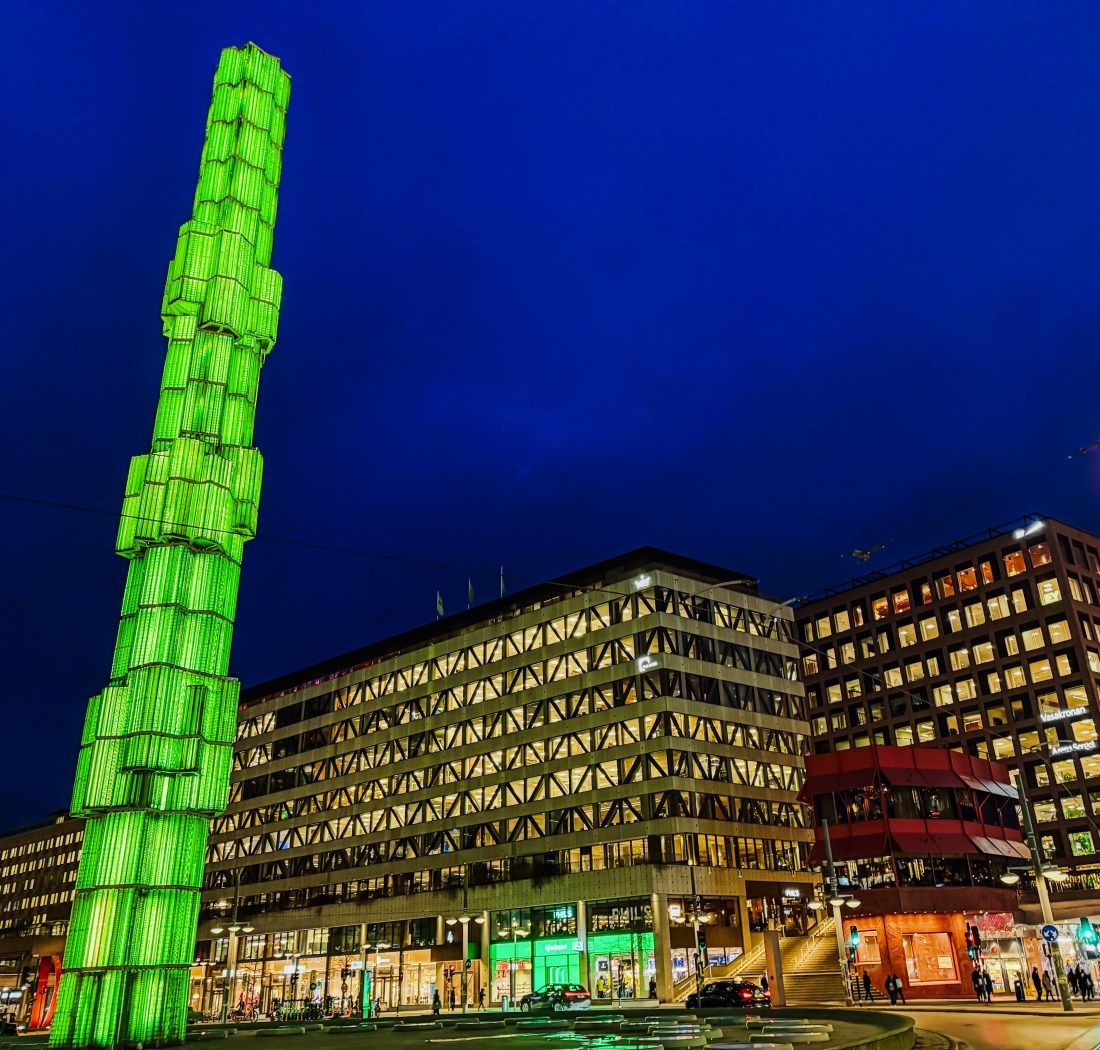
The most recent stop in our QED tour of European fintech ecosystems was Sweden, where we used the occasion of Stockholm Fintech Week to meet some of the best founders in Europe.
We are by no means strangers to Sweden: Apart from having been born there myself, Nigel Morris also served on the board of Klarna in the early days, helping them with everything from credit underwriting to international expansion during those formative years.
So consider this “top five” take the latest installment in a Nordic saga that has been close to our hearts for more than a decade.
Impression #1: Sweden goes for the European AI crown
The cutting edge of innovation is very much happening in Sweden.
From Lovable to Legora, just to name two recent examples, Swedish AI is breaking out and the next generation of companies are getting funded with big tickets. It was also quite remarkable how plugged in the latest generation of founders were to the US and the rest of the world.
What seems to really differentiate Sweden in the AI context today is the focus on practical application layers, the amount of funding coming in from the US, the sheer number of AI start-ups per capita, and the recent success stories that are fueling the virtuous cycle.
There is also a lot of thought around globally focused vertical AI solutions, that bundle AI with a regulated layer, thus creating moats in a field that has the risk of being commoditized or overtaken by the big foundational companies. This shows that Swedish founders are very much at the forefront of how to build defensively in the age of AI.
This was indeed probably the most interesting pattern we saw: the best founders are not building horizontal AI, they are embedding AI into regulated verticals, creating defensibility where others risk commoditization.
Based on the founders we met this week, the best is yet to come, and just like Spotify came to dominate music streaming, we strongly feel Sweden will continue to produce global winners in AI.
Impression #2: Founders are thinking big and global, and the world is noticing
There is no shortage of global fintechs that have come out from Sweden, and Klarna, Zettle, Trustly, and Tink are just a few recent examples, not to mention Spotify and Skype from prior decades. Early employees and new entrepreneurs are quickly spinning out of these and other household names, and global funds from the US and Europe are flocking to Stockholm to back them.
As a result, a lot of founders are getting funding with very big rounds while still in stealth mode, and these newly funded founders are certainly thinking big. In other words, the winners and household names of tomorrow are being funded now as we speak.
Another very important factor here is that the relatively small global market of Sweden forces founders to think internationally pretty much from Day 1.
Impression #3: The ecosystem is small, but very concentrated
As we learn in microeconomics, a concentrated but large benefit tends to win over an equal but distributed cost. This power of concentration is very much evident in the Stockholm fintech scene. Compared to a place like London that is much bigger, the fintech (and tech) scene in Sweden feels very tight, very motivated, very focused, and very much ready to take on the world.
There is almost a sense of mission or preordained destiny about many of the founders we met, and from experience we know that this kind of focus is a crucial ingredient for success.
Impression #4: First principle thinking is driving true innovation
As we travel European ecosystems, we see many that are competitive and entrepreneurial. If somebody goes after an idea, others copy it, and build local flavors of globally proven models.
Swedish entrepreneurs however, stand out with more first principle and original thinking, and as a result end up being global trendsetters and innovators compared with many other European countries. A good example of this outside the world of tech is how the safety obsessed culture of Sweden gave us the seat belt which was invented by Volvo employee Nils Bohlin in 1959.
Impression #5: Sweden has become very wealth and entrepreneur friendly
This goes against many people’s stereotype of Sweden, but Sweden has quietly become very wealth friendly over the last couple of decades. Since 2005 there is not inheritance tax, and since 2007 there is not wealth tax. Capital gains tax is effectively flat and can be quite low, and stock options were reformed in 2018.
Add to this the fact that a high safety net drives higher risk taking, along with the deep tech and engineering culture, and it should not come as a surprise that Sweden actually has 2x more billionaires per capita compared to the United States. Twice as many.
So from the days when we sat of the board of Klarna to today, we remain excited about Sweden. Stockholm is now Europe’s most efficient AI factory, and if you are not spending time in Stockholm right now, you are missing where European AI is actually being built.

 Yusuf's blog