Numerical Context on the Proposed Fiscal Stimulus

In my last blog I wrote about the immediate need for helicopter money and coordinated fiscal stimulus from governments around the world. Since then the US administration announced a $850bn stimulus package. I would like to share some numbers to put the figures being proposed by US political leaders into context.

The GDP of the United States was $21.4 trillion in 2019. This means that on average, the US produced a GDP of $1.8 trillion/month in 2019. Obviously, even with all the measures put in place in response to the coronavirus, we are very far from having shutdown the entire economy. But what percent of the economic output has been impacted by the partial shutdown and economic disruption?

To give us an idea, we can actually use the latest economic data shared by China yesterday. According to the National Bureau of Statistics, industrial output in China tumbled by 13.5% in the first two months of the year. As per the Financial Times, the same data also showed that retail sales plummeted 20.5 per cent year on year in January and February, and fixed asset investment fell 24.5 per cent. Services production also declined by 13 per cent in the first two months, and coupled with the industrial production figure, Capital Economics estimates that Chinese GDP contracted by 13 per cent during the first two months of the year. (Source: Financial Times, Chinese economy suffers record blow from coronavirus.)

However, while the data above suggests a 13 per cent drop over two months, it is important to note that China only went into full lockdown on January 23rd. Considering that February is a shorter month, the contraction primarily corresponds to a period of thirty-seven days. Putting this into monthly terms, a reasonable assumption is that China’s economy contracted by 10.5 per cent on a monthly basis during the lockdown period.

Taking this 10.5 per cent number and applying it to the US monthly GDP of 1.8 trillion, we see that the GDP impact of going into shutdown for one full month is about 190 billion dollars, or close to one percentage point of annual GDP each month the shutdown is in place. This sort of math is of course way too simplified, but it helps give a directional understanding, and it seems to imply that by proposing a $850bn stimulus package the current US administration is looking to make up for about three to four months of lost output from slowing down economic activity in response to the coronavirus.

What the numbers do not take into account is follow on disruptions that may be caused as people lose their jobs or companies have to go out of business permanently. It also does not take into account any disruptions from stress building up in the financial system such as the repo or commercial paper markets. Nonetheless, one can only hope that it will inject markets and people with a sense of stability. The delivery mechanisms will also be key, as the stimulus needs to reach the people and businesses that need it most in an expedient manner.

The most important thing to note here however is that the US is far from the only country impacted by the coronavirus. The GDP of the EU is close to $20 trillion, and their economic output have certainly been exposed to the same sorts of unprecedented shocks. Hence, it will be very important that other governments continue to take similar fiscal measures in the coming days, and do so in a coordinated manner.

It Is Time for Helicopter Money

We are living through unprecedented times. Never before has the global economy been this interconnected, and never before have the seven billion plus souls that inhibit this planet changed their collective behavior so suddenly and so dramatically.

The global wave of fear that the COVID-19 virus and the associated media coverage has unleashed has created a tsunami of reactions, with borders closing, factories shutting down, and both the demand and supply side of the economy going into what can best be described as shock.

The health and safety of the world’s citizens should be priority number one, and I would first and foremost like to express my eternal gratitude to the nurses, doctors and medical workers who are working on the frontlines of this pandemic to the point of utter exhaustion, putting their lives at risk on a daily basis to save ours. We are deeply grateful, and words are not enough to express the importance of the work that they do for all of our collective safety.

As for the global political response, I am neither a scientist nor an epidemiologist, so I will not get into the controversial topic of whether the response from the various national governments of the world has been an overreaction or an underreaction.  I would however like to point out that in times of crisis, coordination and solidarity is paramount, as is staying calm and levelheaded. Politicians globally face no easy choices in the coming weeks. It is the job of our leaders to make these incredibly difficult choices, always putting the good of society and the health of all the world’s citizens as the top priority. Sometimes the right choice might not be the most popular one, and it is the job of the leader to make that right choice in light of scientific knowledge and the long-term welfare of society. Open and honest communication that also prioritizes keeping the population as calm as possible will be key.

While nothing can be more important than preserving people’s physical health and wellbeing, I would like to focus here on the economic consequences of what we are going through. I will not go into the numbers here, but the analogy with regards to the global economy that comes to mind is a big airliner that has shut its engines in midflight. We now need to restart the engines and land the plane safely.

The Fed has announced that it has cut its rates to zero percent, so it is fair to say monetary policy is stretched to its maximum. However, while this will undoubtedly help, it will likely not be enough.

Given that the global economy faces an unprecedented challenge, global policy makers now need to focus on unprecedented economic responses. Given that the shock is driven by both the supply side (factories shutting down, supply chains breaking down) and demand side (consumers not spending money and postponing most purchase decisions), governments will have to take swift steps to address both sides.

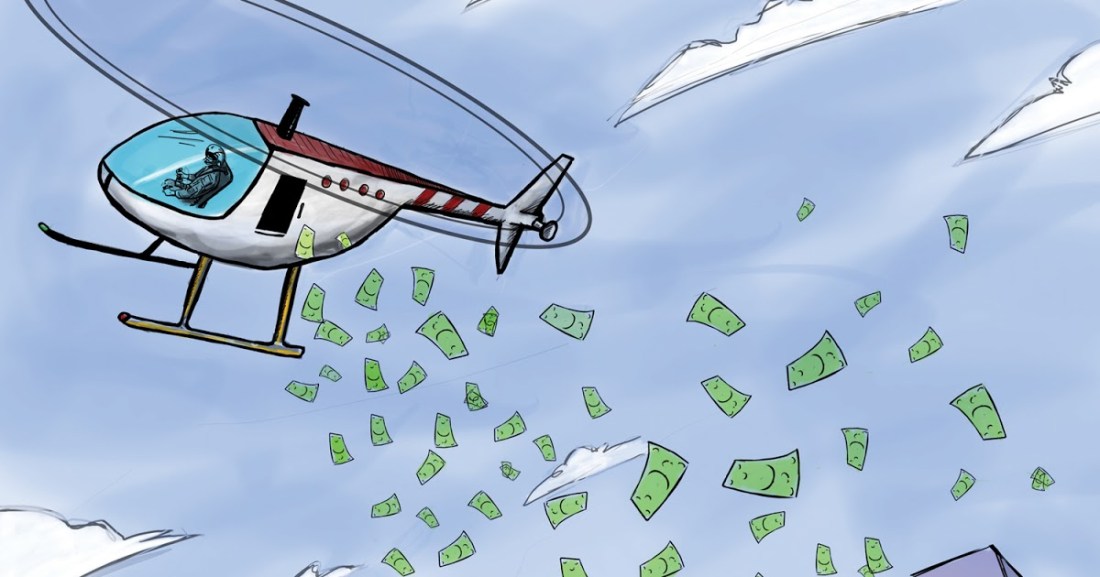
The term helicopter money is derived from a thought experiment by Milton Friedman

One such step would be what is known as “helicopter money” a term attributed to a thought experiment performed by Milton Friedman, where a helicopter drops money that is directly picked up by the people. One key condition of his thought experiment is that everyone is convinced that this is a unique event that will never be repeated. This thought experiment has since been picked up by economists as an alternative (or supplement) to monetary policy including quantitative easing. Its proponents argue that it can be a very efficient way to increase aggregate demand, especially in what is known as the liquidity trap – or central banks reaching the zero lower bound on interest rates.

The proponents of this tool include Ben Bernanke, who has in the past stated that helicopter money should be on the table as an alternative of last resort.

In practice, there are clearly many ways in which helicopter money can be implemented. The spectrum can range from tax credits to individuals and small businesses (the mildest form) to actually transferring money directly into their bank accounts (basically a sort of temporary Universal Basic Income for the duration of this crisis).

Given the severity of our current crisis, I think policy makers need to immediately start assessing the various delivery mechanisms and preparing an action plan as soon as possible. The best option in today’s circumstances is likely to be one where small businesses and consumers get money put directly into their bank account. While the cost of this will undoubtedly be high (using a simple example, giving forty million people GBP 1,000 per month equates to a cost of forty billion pounds for each month that the policy is in place).

However, if the benefit is to prevent a total breakdown of the economy, the cost may be very worthwhile indeed. The delivery mechanisms will also be key, and alternatives that help small businesses stay solvent also need to be considered. This can take many forms including a forcing mechanism to direct the helicopter money to be spent immediately, or other direct assistance to small businesses, including payroll support where the money in effect gets delivered via business payroll. One big benefit of this would also be to give consumers one less thing to worry about. Everybody is clearly very worried about their physical health and wellbeing, and adding financial worries on top of this only increases the level of stress.

Finally, it is also important to point out that one big benefit of helicopter money is that it would create less inequality and would thus help maintain social stability and cohesion in trying times. Quantitative easing primarily gets delivered via the banking system and tends to flow towards house prices and stock prices, which then tend to leave behind people that cannot afford to own a home or buy stocks.

We need to remember that (God willing) this too shall pass, and once it does, we want to wake up to societies that have made it through these troubling times with their heads held high, in solidarity with their fellow people and neighbors, and without sacrificing the fundamental values on which we have built our civilization.